伊澤大使の第4回ブリュッセル インド太平洋対話出席
令和7年12月2日
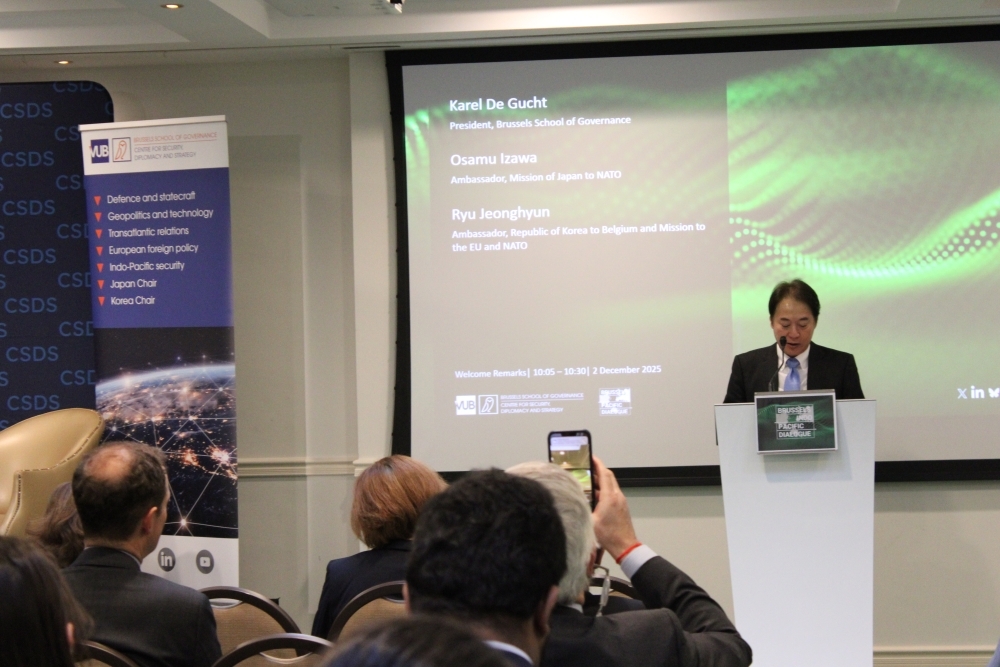
12月2日、伊澤大使は、ブリュッセル自由大学安全保障・外交・戦略研究所(VUB-CSDS)主催「第4回ブリュッセル インド太平洋対話」に出席し、開会の挨拶を行いました。
伊澤大使冒頭発言
(As delivered)
It is a great honor for me to present the welcoming remarks at the Fourth edition of “Brussels Indo-Pacific Dialogue”. As you may know, in January of this year, the Mission of Japan to NATO was inaugurated as an independent mission to reflect the recent rapid development of Japan-NATO relations.
We have worked closely with the Japan Chair at the CSDS, which was established in 2022 with the support of the Government of Japan. I wish to express our profound respect and appreciation for the continuous efforts of the CSDS in holding this highly important dialogue today.
Recognizing that security in the Euro-Atlantic and Indo-Pacific is increasingly inseparable, Japan has been building up substantial cooperation with countries in the Euro-Atlantic. Today, I would like to touch on landmark examples of unit-to-unit exchanges, support to Ukraine, and defense industry cooperation.
First, let me give you a couple of examples of the increased unit-to-unit exchanges. This year, in August, the Norwegian Navy frigate Roald Amundsen visited Japan for its first-ever deployment to the Indo-Pacific, and the UK Carrier Strike Group led by the Prince of Wales made port calls to Japan for the first time in four years. Additionally, our Maritime Self-Defense Force conducted joint training with the U.S., Australian, and Spanish navies.
In mid-September, we dispatched four F-15 fighter jets, supported by two aerial refueling tankers and two C-2 transport planes to air bases in the US, Canada, the UK, and Germany. The two-week friendly visit, known as "Atlantic Eagles," marked the first time that our Air Self-Defense Force fighter jets were deployed to Europe and Canada. Japan also actively participates in joint exercises, including "Vigilant Isles 25", a field exercise which our Ground Self-Defense Force conducted with the British Army in Hokkaido last month.Through such exchanges and exercises, Japan aims to deepen mutual understanding with European militaries and further promote defense cooperation with allies and like-minded countries toward the realization of a free and open Indo-Pacific.
Second, let’s look at Japan’s support to Ukraine. Russia's invasion of Ukraine is violence that undermines the foundations of the international order and is a clear violation of international law. The Japanese people have provided unwavering support to Ukraine, based on a sense of crisis that "today's Ukraine could be tomorrow's East Asia."
Our government has pledged assistance to Ukraine totaling more than 12 billion dollars and plans to provide around 3.3 billion dollars in loans as part of the G7’s cooperation. On top of this, Japan announced new sanctions against Russia in September, including lowering the oil price cap and measures against its "shadow fleet".
The Japanese government has contributed around 85 million euros in total to the NATO CAP Trust Fund, supporting Counter-UAS, medical supplies, military medical care and rehabilitation, demining, and others. Moreover, we are currently working towards joining the NSATU as soon as possible.
Finally, I would like to touch on defense industry cooperation. Prime Minister Takaichi pledged to increase Japan’s defense budget to 2% of GDP by the end of the current fiscal year to fundamentally strengthen its defense capabilities, ahead of the original target set in 2027. The increased defense budget creates opportunities to promote Japan’s defense industry and dual-use technology cooperation internationally.
While our country has traditionally cooperated almost exclusively with the US, it is now working on to diversify its defense industry cooperation. The GCAP, a joint development collaboration with the UK and Italy to develop next-generation fighter aircraft, and cooperation with Australia to develop a new general-purpose frigate are two flagship projects in this regard.
Additionally, as a close NATO partner, Japan can contribute to strengthening NATO’s supply chain by transferring “parts and components”. The smooth transfer of these materials requires interoperability and interchangeability with NATO Allies. The first Japan-NATO Defense Equipment and Industry Dialogue, held this past October, was a significant step forward in laying the foundation for such cooperation.
The inseparability of the Euro-Atlantic and Indo-Pacific led to dramatic advances in defense and security cooperation between us. The Fourth Brussels Indo-Pacific Dialogue will be a valuable opportunity to explore guidelines for how our two regions should move forward to strengthen defense and deterrence and navigate geopolitical uncertainty.
I would like to conclude my remarks by wishing for a fruitful discussion. Thank you for your kind attention.